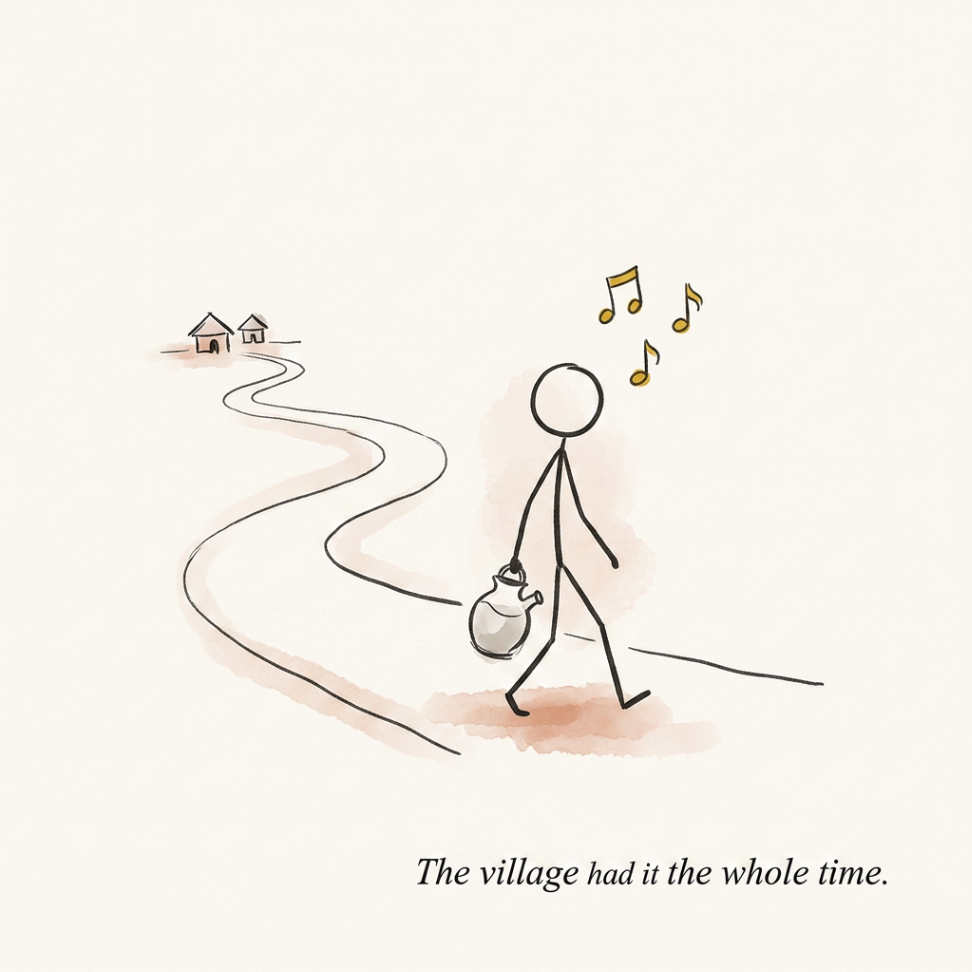
There's a village in Zimbabwe that Vishen Lakhiani visited a few weeks ago. He tells the story in a video I watched after I stumbled upon his Substack profile the other day. The family he stayed with is headed by a man named Lovemore. They keep about fifteen cows. The boys wake up and go check on them every morning. The women harvest the fields and pound the grain together, singing as they work. There's no running water, so the women walk three kilometers to fetch it, as a group, talking the whole way there and back.
It has run this way for thousands of years.
Then the government showed up with good intentions. They brought in pipes for the water. Machines to help with harvesting the grain and milking the cows. This led to five or six hours of daily work for the villagers disappearing almost overnight.
From the perspective of the average American and their relationship with work, and especially manual labor, you might expect a celebration around something like this. But Vishen points out that what usually happens in situations like this is almost the opposite. The walking three kilometers a day and the pounding of the grain was never just a chore for these people. It was the fabric of their daily lives and a source of deep connection amongst their community. These activities were where the conversations and the joyful singing happened, where a boy learned what his role was in the society, and how he could be of service. The point Vishen is leading us to can be wrapped up in this powerful quote:
"What was a simple society becomes an impoverished society. What shifted? Identity."
With this story in mind, I want to move on to talk about a version of this that might be coming for the rest of us who have grown accustomed to our own way of life and occupation.
the $3,000 forecast
The video I'm describing is Vishen reporting back on his experience at Abundance 360, Peter Diamandis's mastermind for founders. I'll do my best to quickly summarize the story he's trying to paint for us, and the predictions (or plans) that were being made by leaders at this event:
We are beginning to see AI replacing jobs across every industry simultaneously, which is not something we have ever experienced in modern society. It was predicted that governments will respond with a monthly check, around $3,000, which will be funded by taxing the robots that begin to take the jobs. And then this will lead to a massive deflation, because robots will be able to make things so much cheaper. It will get to the point that $3,000 buys what a middle-class salary buys today. Diamandis and Steven Kotler go deeper on this prediction in their new book, We Are as Gods.
Maybe the timeline is off. Maybe the amount of the check is different, or never comes at all. I'm not asking you to bet on the forecast. And I'm not fully sure where I stand on it either, other than it's a fascinating idea to explore.
What I'm asking you to sit with is the question it brought to mind for me, because Diamandis names it himself, on stage, in the middle of a lot of optimism for the future. He called it the biggest crisis we're about to face. A crisis of meaning.
Almost every argument about UBI assumes that if the bills are covered, the problem is solved. Cover the rent and the groceries and people are free.
There's a lot of good to be explored around this idea, but I also know from my own life and direct experience that it's not quite that simple.
The full video is below, and it's fascinating. The three phases, the Alaska model, what a phone would have cost in 1980. Watch it when you're done here, because the rest of what I'm sharing here is about some ideas that are almost skipped over completely.
I got my version of the check early
In my thirties I built a Facebook ads consultancy past $100k a month. More money arrived each month than I knew what to do with. By most of the world's standards, I was living the end goal, the place where work is supposed to stop being necessary.
As my bank account balance climbed, my stress climbed with it, and so did the weight of everything I was now responsible for. It was an accidental business, an opportunity I was riding like a wave, and never something I'd chosen with any true sense of purpose. And somewhere in those years a question showed up that I began to wrestle with.
Is this even what I'm supposed to be doing?
This question led me to learn Vedic meditation. I went on retreat in Costa Rica with a coach I trusted and sat with the bigger version of the question.
What am I actually here for?
Because I couldn't see a life where I just kept going at the pace I was moving, doing the work I was doing. Work is where most of our days go, and I wasn't willing to squeeze my meaning into the small chunks of time left around it. The work itself had to be in service to something greater.
The warning signs kept piling up, in my health and in the rest of my life, until I eventually burned out. A cancer scare followed, and the whole thing came crashing down around me. The search that started on that retreat years ago eventually became the basis for the creation of Sacred Business Flow.
So when Vishen says, "if you identify meaning with work, you are going to go into a mental health crisis," he's describing a place I've been. The money arrived. The questions I was asking myself grew louder.
What is my life actually about?
where I see it differently than Vishen
Vishen's prescription is to stop attaching meaning to work. Find your meaning somewhere else, because work is going away.
I think that's half right. And the half that I believe is wrong is pretty important to explore too.
Go back to the village. The women walking together to get water were working. The singing didn't happen instead of harvesting the grain. It happened alongside it. Their meaning lived in the work itself, done together, in service to the people in their community that they loved.
When their work was taken away, it also took away the sense of connection between these members of the community.
So the way I see it deviates slightly from Vishen's perspective. I've believed for quite some time that it's problematic if you are assigning your meaning to a paycheck.
But what about the work that you would still choose if there was no paycheck in sight?
There's a word for that kind of work. A calling.
Carolina and I call this Sacred Business, building from the desire in your heart and serving it with devotion. The work you'd keep doing even if a $3,000 check covered everything. The decade ahead can take the paycheck from a traditional employer, and maybe the job with it. What it can't take is work you've chosen on purpose, because that choice was never resting on the foundation of money as the sole reason for getting up every morning.
Many people already understand this, and are living from this space now. You don't need the predictions in this video to come true to benefit from knowing what that work is.
I am living into this now. Most mornings there's a pull toward the chair, an I get to do this. And I've watched the same thing switch on for clients the moment they lock onto their version of it.
the answers that came back
A few days ago I asked a question on Substack. What's the one part of your work you'd keep doing even if it never paid you again? Not the mission-statement answer. The actual task. The thing your hands would miss.
Nobody named a beach.
Ashton would keep doing deals. He loves the back and forth of a negotiation, which made me smile, because deals are literally about money and he'd keep running them with the paycheck gone. Duncan would keep teaching people how to be safer and more confident in their own skin, and he named the condition himself: even if it never paid.
Joey would keep coaching, for the moment a person sees their own situation in a new light. Michele would still write and teach. Nikki reads the Akashic Records every day and isn't planning to stop. For Inge it's the questions, the ones that walk someone back to the source of what hurts. Amanda would keep sitting with people while they say their bigger hopes out loud. Josh pictured himself with a camera in one hand and an NA drink in the other. And Andrew would keep listening for what's underneath what a person says out loud.
Carolina answered too. Embodiment classes. I didn't have to ask.
Every one of those answers is work. Real tasks, most of them done for other people. Not one of them needs a salary attached to keep its meaning, and not one of them disappears when the check arrives. The village had it the whole time.
seven mornings
Vishen ends the video with a question borrowed from his own talk, Soul Pact. If your work became optional, what would you want your life to be about? Not the answer you think you should give, he says. The real one.
Here's the experiment. Every morning for a week, write your answer to that question. Don't try to build out any grand plans. Just answer it as honestly as you can for seven days in a row. Notice any patterns you start to see showing up.
And notice where you feel those answers in your body.
Some of you will do this exercise and find the answer already matches the life you're currently living. Keep going. If yours doesn't match, and you want to explore that, this is exactly what Carolina and I help people do.
Either way, you don't have to wait for any government to act. The question is already available to work with. Find your answer now, while it's still a choice.
Phil (& Carolina)