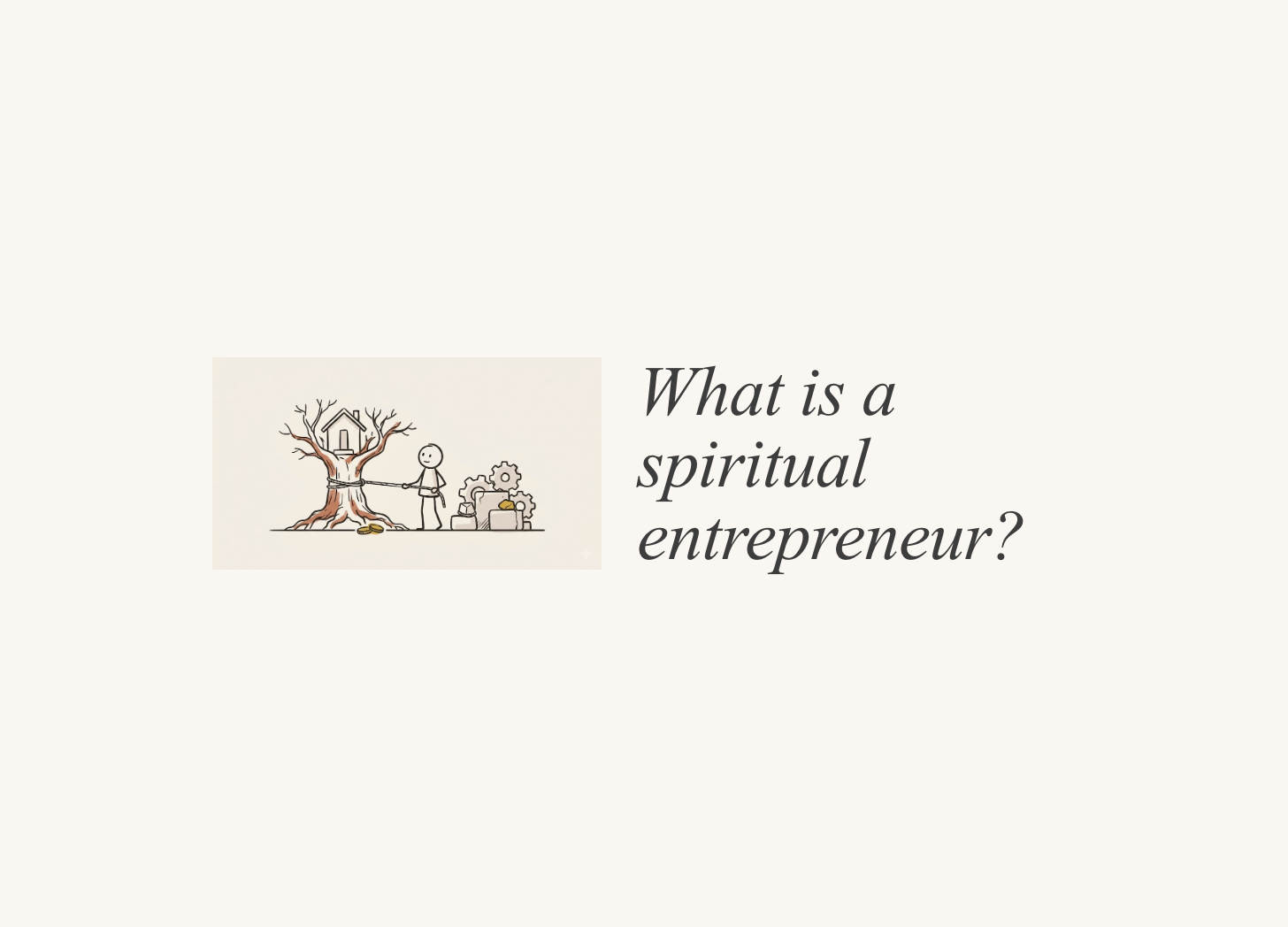
What Is a Spiritual Entrepreneur?
Some people start a business because they spot a gap in the market. Others start because they can't ignore the work they feel pulled to do.
If you're wondering what a spiritual entrepreneur actually is, here's the plain version. A spiritual entrepreneur is someone who builds a business around purpose, service, and inner alignment, and still runs it like a real business with revenue, structure, and growth. It's not a hobby with a nicer label on it. It's entrepreneurship that happens to be rooted in meaning.
That difference matters, because a lot of spiritually minded founders have been taught to split themselves in two. One part is the healer, coach, guide, or practitioner. The other part is the business owner who feels pressure to market and sell in ways that don't feel true. A spiritual entrepreneur doesn't win by walking away from their values. They build a model that makes room for both the mission and the money.
What is a spiritual entrepreneur, really?
A spiritual entrepreneur isn't defined by a religion, an aesthetic, or a certain set of words. They're defined by how they relate to their work.
Usually this kind of founder sees the business as an extension of their calling. They might offer coaching, healing, intuitive guidance, education, wellness, or some form of transformation support. The work isn't only about delivering a service. It's about helping people change, heal, reconnect, or move through something big in their life.
But being a spiritual entrepreneur doesn't mean throwing out business fundamentals. That's actually where a lot of people get stuck. They assume spirituality and profit are somehow at odds. They believe charging money waters down the work, or that systems and sales language make them less authentic.
Neither one is true.
Structure can support the sacred. Clear offers help people say yes. Healthy pricing keeps you in business long enough to help anyone at all. Consistent marketing helps the right people find you. Boundaries protect your energy and make the client experience better. Strategy and intuition work together, and used well, strategy gives your intuition somewhere to land. That balance, structure in service of the sacred, is the whole idea behind Sacred Business.
The difference between spiritual work and spiritual entrepreneurship
Not everyone doing meaningful work is a spiritual entrepreneur.
You can be gifted, intuitive, and genuinely helpful to people without ever building a business. Plenty of practitioners stay in a loop of informal referrals, underpriced sessions, fuzzy messaging, and income that's all over the place. The work helps people. The business underneath it is thin or missing.
Spiritual entrepreneurship starts when you go from offering the occasional bit of support to building something sustainable around the work. That means deciding who you help, getting your offers clear, setting prices, saying what your work is worth, and making decisions with both discernment and responsibility.
This is where identity comes in. A spiritual entrepreneur isn't just someone who happens to be spiritual and self-employed. They're someone willing to let their values shape how they build, not only what they sell.
Sometimes that means refusing manipulative marketing. Sometimes it means designing a business that respects your energy instead of treating burnout like a badge. Sometimes it means building client experiences that feel honest and clear. And sometimes it just means having the nerve to simplify your message so people can actually understand what you do for them.
Common traits of a spiritual entrepreneur
Most spiritual entrepreneurs share a few things, even when their businesses look nothing alike from the outside.
They're mission-led. They care about impact, not only income. The business exists because they want to put something meaningful into the world.
They pay attention to alignment. Intuition, energy, integrity, and internal truth all factor into how they make calls. That doesn't mean every decision is mystical or run on feelings. It means they won't build success on top of self-betrayal.
They're service-based. A lot of them work in coaching, healing, wellness, embodiment, personal growth, or transformation education. The business runs on relationships, trust, and real client outcomes, not high-volume transactions.
And they tend to wrestle with visibility, pricing, and structure more than the average founder. Not because they can't do it. Because the work feels personal. Selling something this close to you can feel exposing, packaging it can feel like you're shrinking it, and picking a niche can feel like you're leaving people out.
Those tensions are real. They don't mean you're not cut out for business. They usually mean your business needs to be built in a way that respects what the work actually is.
What a spiritual entrepreneur is not
A spiritual entrepreneur is not someone who avoids planning and calls it flow.
This path attracts vague messaging and fear dressed up as intuition. People say they're waiting for alignment when they're really putting off clarity. They keep changing offers because commitment feels too exposed. They undercharge in the name of service, then quietly resent the clients or burn out on the work.
This is honest territory. Alignment and comfort aren't the same thing, and intuition was never a reason to skip building real skills. Purpose doesn't do positioning's job for it.
And you don't have to be perfect at any of this. You don't need every spiritual belief figured out, and you don't need a business that looks mystical from the outside. Some spiritual entrepreneurs are openly intuitive in their branding and their client work. Others are quiet and grounded about that side of things. Both can be fully aligned.
Why this path feels different from regular business advice
Most business advice assumes more force equals more growth. Push harder, post more, sell faster, scale quicker, detach from emotion, optimize everything.
For a lot of spiritual entrepreneurs that approach feels hollow at best and harmful at worst. It can get you short-term results. But if the method disconnects you from your values, your body, or your purpose, the business starts to feel heavy even while the numbers go up.
That doesn't mean conventional strategy is all wrong. Plenty of business principles hold no matter what you do. You still need a clear audience, an offer people want, strong messaging, and a real path to revenue. How you apply those principles is what changes.
A spiritually aligned business tends to grow through resonance instead of pressure. It values trust over manufactured urgency, and it cares more about real client outcomes than flashy claims. There's room in it for seasons, for capacity, and for the fact that you're a human being with limits.
There are trade-offs here, and I won't pretend otherwise. The gentler path isn't always the fastest one. A heart-led business that's built around you can take longer to simplify and scale. The upside is that a business built in alignment is usually easier to sustain over the long run, because it never asks you to become someone else just to keep it running.
What spiritual entrepreneurship looks like in practice
In real life, a spiritual entrepreneur might be a trauma-informed coach building a signature program, a Reiki practitioner mapping out a clearer path for clients, or a wellness educator tightening the message so the right people finally get what's on offer.
It might look like raising your rates to match what the work is really worth, building an intake process that protects your energy, or writing sales copy that's honest instead of performative. It can mean choosing a business model that works with your nervous system instead of running it into the ground.
This work runs in two directions at once, inner and outer.
You might need to heal your relationship with visibility, money, authority, and receiving. You might also need better offer design, clearer marketing language, and systems that actually hold up. One without the other creates friction. Inner alignment with no strategy stays abstract, and strategy with no alignment eventually starts to feel empty.
That's why a business like this often needs a different kind of support. Sacred Business speaks to exactly this intersection, because spiritual entrepreneurs don't need less business structure. They need structure that fits the truth of the work.
How to know if you're a spiritual entrepreneur
You might be a spiritual entrepreneur if you feel called to serve through your business, but you're not willing to get there by overriding your values. You care about real change. You want clear offers, steady income, and growth that feels clean instead of forced.
You might also recognize yourself here if you've outgrown being "the gifted one" or "the passionate one." You're becoming someone who can hold a mission like an adult. That includes being visible, making decisions, setting boundaries, and letting the work get more structured so it can reach more people.
You don't have to choose between spirit and strategy. The whole point is becoming the kind of leader who runs on both.
A spiritual entrepreneur treats the work as sacred and the business as worth real skill, care, and intention. If that's what you're building, you don't have to get louder or more aggressive to grow. People who've done the inner work usually just need a business strong enough to hold the calling, one that lets them bring all of who they are forward instead of fragmenting themselves to succeed. That's the kind of business Sacred Business exists to help spiritual entrepreneurs build.