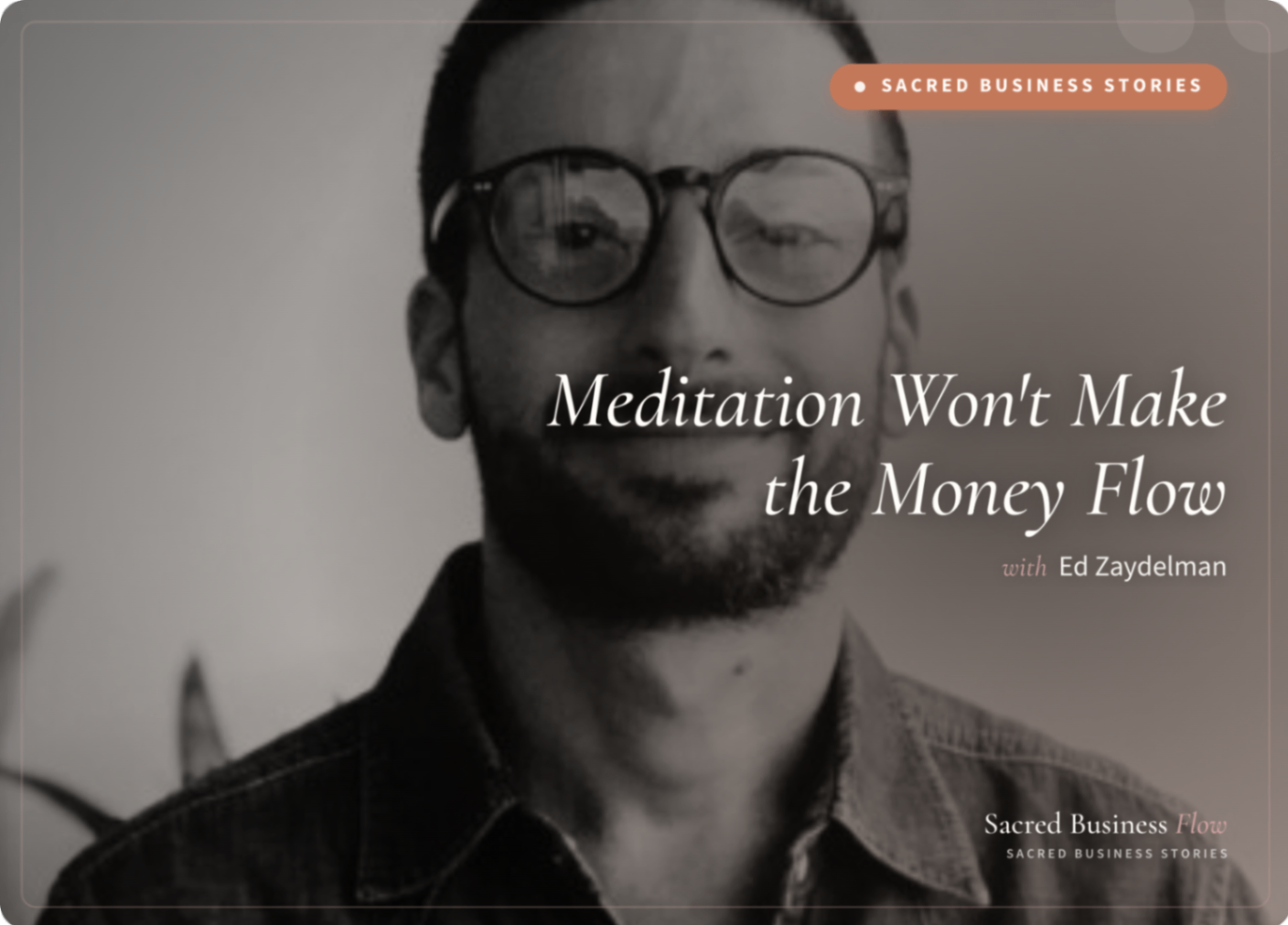
Twenty years ago, Ed Zaydelman was driving a beat-up old Suzuki along a Costa Rican ridge, looking at land. The Suzuki almost rolled off a cliff once. That was the welcome.
He had left New York. His family had bought three different properties, and his job was to create the vision for them, build a team, put together a deck, and raise the capital.
What he wanted was simple. He wanted to build a place where people could actually live well, not just visit for a week and go home.
The hard part was that Ed thought belief was a plan. He'd had what felt like a download from God to build an eco-village and wellness retreat center, and he took the feeling of being guided as proof it would work. Then the 2008 real estate crash hit. He had architects and engineers on master plans, and the money dried up. He started pitching the dream anywhere he could. He raised a couple million dollars at Burning Man. But it was all stress led. If they didn't raise enough, the bank would take one of the properties. It cost him his marriage.
You can't just sit on a couch and meditate and hope that the money will just flow in.
That's Ed now, saying the thing he wishes someone had said to him then. Back then he was running his first retreat center out of thirty glamping tents, an old rancho, a pool, and a kitchen built around a two-burner stove. He calls getting it off the ground the feat of a lifetime. He also burned out, hit his dark night of the soul, and watched it come apart.
The public arc is cleaner than the lived one. Ed grew up in New York nightlife, organizing events and clubs. He did a stint with the Burning Man organization, which he describes as a PhD in how to build community, watching 70,000 people put up a pop-up city with a gifting economy and no money. When his grandfather got pancreatic cancer, his family turned toward longevity and lifestyle, and Costa Rica checked every box. He moved, built, sold his retreat center to a hotel group, and today advises people building retreat centers, homes, and land projects in Costa Rica, Mexico, the US, and Europe. He writes a Substack with more than four thousand subscribers.
We had Ed on Sacred Business Stories this week to trace the arc. The part most people don't hear is what happened in the gap between losing the first vision and finding the work he does now.
When the hotel group took the retreat center, Ed says it felt like selling a boat. They handed him a bigger offer too. Build us 100 retreat centers in five years. He said sure. Then he sat in a board meeting in New York, the funny guy in sandals who skipped the 9am stand-up because he had yoga, and the investment committee told him they were cutting his permaculture budget. Anyone building a real retreat center knows you need the food forest, the fruit trees, the gardens. That was the moment he understood they were a scaling machine, a good one, just not the people he could build his thing with.
Thank God we didn't do that, because that business would have run me into the ground again.
Then COVID gave him a pause, and he ran into me. I told him what was obvious from the outside. He knew more about building these projects than almost anyone, most of it learned from his own mistakes, and he could turn that into something in service to other people. We spent about nine months building the offering. Somewhere in there I told him he was a coach, and he hated it.
An advisor just gives you advice. A coach really cares about the outcomes. They care about seeing your life through.
That's the distinction that flipped it for him.
Two moments from the conversation stuck with us.
The first was about honesty, the kind you turn on yourself first.
Does the world need a bunch of eco-villages? Does the world need more retreat centers? What are we retreating from?
Ed has watched plenty of eco-villages go up where the physical structures are beautiful and the invisible ones are missing. People who can't run a hard conversation end up fighting about the chickens in the chicken coop, vegans against non-vegans, whose dog belongs where. His read is that the real problem is people, and the work worth doing is helping them learn how to come together. That's a different business than pouring concrete.
The second was about not knowing.
It's okay to say, I don't know.
He tells clients to take their shoes off and walk the land barefoot, then asks what the land is telling them. Does it want one big structure, or a lot of small cabins? He coaches two billionaires who, by their own admission, know more than he does about development. They hired him anyway, because what they needed was a sounding board and someone who would tell them the truth. He stopped pretending the value was in having every answer.
His advice for anyone sitting on something they're afraid to share is plain.
Just write and share and post and call and have meetings with people that you're drawn to. The rest will come.
The belief Ed's story challenges is the one that says you have to build something monumental to count. For years a quiet fear ran underneath his work, that he had to do something huge to be worthy, and people kept offering to fund exactly that. He turned it down. He'd seen that you can build an eco rat race just as fast as any other kind, even in the jungle. The work he actually wanted was smaller and steadier. One project this year is a collective house for four people.
He scaled the vision down and found the business inside it. That's the part worth sitting with. The version of his work that serves people best is the one that stopped trying to prove anything.
You can find Ed writing at livethepossibility.news.
He's for the person who's been dreaming about a retreat center, an eco-village, or a piece of land with friends on it, and for anyone in the middle of a big life shift who's about to move somewhere and start over. He'll tell you the truth about it before you spend the money.
Watch the full replay. He's honest in a way most people in this space aren't.