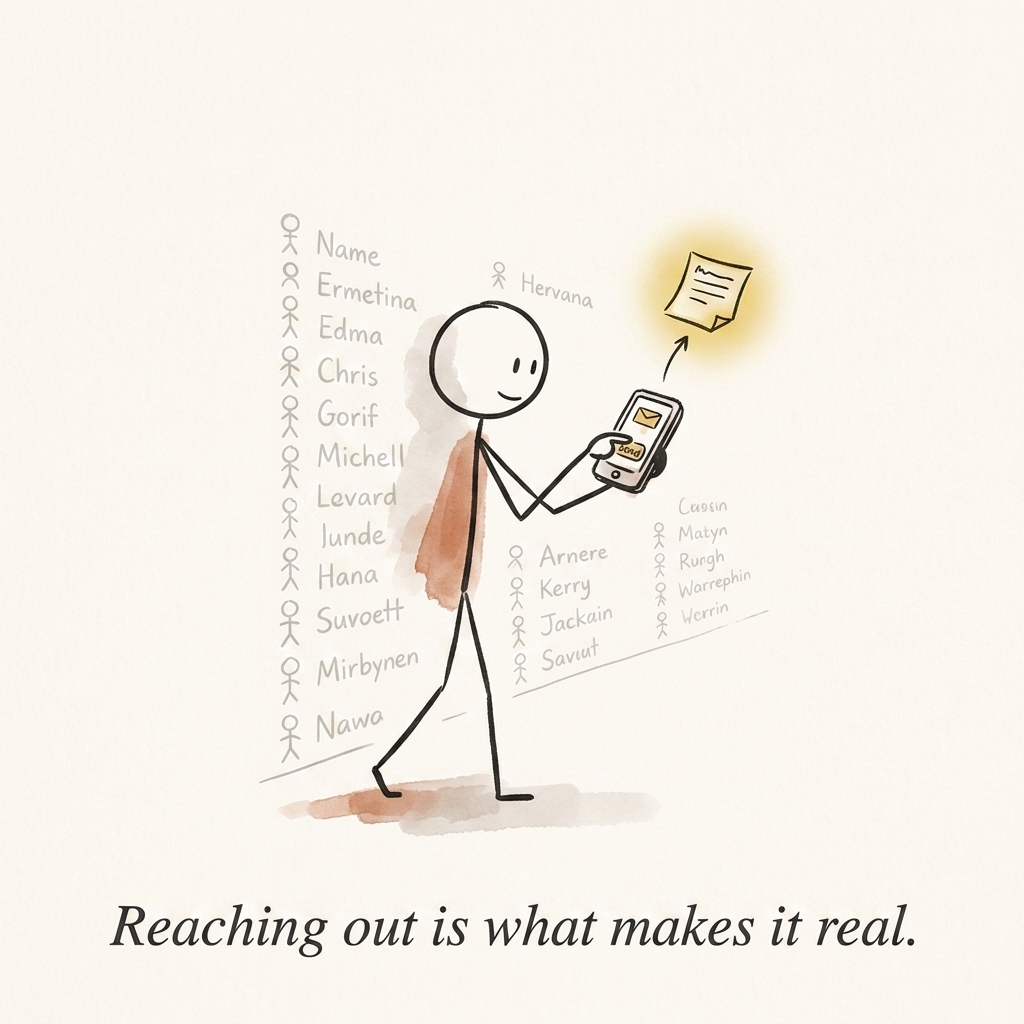
Someone on our community call last week made a list of about a hundred warm contacts. Past clients, old colleagues, people who would be glad to hear from him and probably glad to help. Then he told us how many of them he'd actually messaged.
Zero.
He wasn't confused about how to send a message. He's a grown man with a phone. Sure, he had a few strategic questions we addressed, but he knew the names, he had the contact information, and the list was right there in front of him. And the list just kept sitting
If you've got your own version of that list, this is for you. There are two parts we are going to unpack together. The first is the method, which I think you'll find is very simple. The second is the reason the outreach often sits there undone, and that's the part I'm hoping you'll get some fresh perspective on here.
start by bucketing your list
Whether 10 people or 100 people come to mind for you, this isn't one audience. It's a stack of very different relationship contexts.
So before you write a single message, dump out your list on to a spreadsheet, or a piece of paper and sort it.
By context: past clients, past colleagues, past collaborators, friends, the mentor you lost touch with.
By closeness: the person you'd call out of the blue versus the person you've only ever left a comment on their Substack article or Facebook post. And by who can actually open a door for you, because some of these people could change the entire trajectory of your month with one introduction. Others - maybe not so much, and that's fine.
When you do this, something useful starts to happen quite magically. The list stops looking like a wall of messy possibilities, and starts sorting itself into who you know you should reach out to first.
match the channel to the closeness
Here is one rule I use without thinking about it these days when I do this for myself. Reach out on the "channel" where you already have the most closeness, or intimacy with that person.
There's a natural ladder to it. Some people I've only ever traded comments with on Substack. Some I'm in the DMs with. Some I have an email thread going back years. The majority of past and current clients and community members are on my WhatsApp. A few I'd text on their actual phone. And a small number I'd just call, no warning, no meeting booked, because we're close enough that a ringing phone from me is a good thing and not an intrusion.
Find the highest rung you genuinely have with each person, and start there. A voice note to someone who's already on your WhatsApp lands warm. The same words in a careful email to that same person land like a pitch.
make the first ask binary (yes/no)
This is the part of the process that's easy to overcomplicate if you aren't careful.
When you reach out, don't explain your whole bright, new, shiny offer. Don't write a wall of words and paragraphs. Make the first ask a single yes-or-no. I did exactly this yesterday with someone I want to collaborate with. I could have sent her a wall of text about the idea. Instead I sent one line.
"I've got a cool idea I've been playing with and I thought of you. Would it be okay if I sent you a quick audio about it?"
That was the whole message. A simple question she can answer in three seconds or less. Easy to say yes to, and easy to file for later without ghosting me. Because news flash: busy people are not sitting around just waiting to hear from you. They're clearing fifty emails and trying to get to lunch, the gym, or to pick up their kids from school. A binary ask respects that. A three-paragraph ask gets moved to "later," and in my experience, later mostly never comes.
You get a bonus read out of this approach as well. How fast someone says yes tells you how "warm" they are. A reply in thirty seconds is a signal, so match it and move quick. A reply a week later is also information. Neither one is good or bad. Both tell you where your attention is a priority.
when you're reconnecting, lead with curiosity, not the referral
Many of these contacts are likely to be people you haven't spoken to in years. The instinct is to lead with the ask. "Do you know anyone who might need what I do?"
Skip that. A cold referral ask earns you a polite "sure, I'll keep someone in mind," and then usually results in nothing. Someone in our community named it directly and better than I could describe it: people tell her all the time that they refer her everywhere, and it has never once produced an actual client. The warm words cost them nothing, and yet they often result in no forward movement.
A curiosity hook does the opposite. For an old contact you've lost touch with, something like, "It's been a while. I still think about the conversations we used to have before I moved. I've been building something new I'd love to catch you up on. Open to hearing about it?"
No hard ask. Just an open door. And almost always they walk back through it , asking what you've been up to, which is the opening you are looking for, the invitation, and permission to share.
now the part that's actually in the way ...
Everything above is simple. I'm sure reading about it took you only a couple minutes. So why does the list often sit there with no forward movement?
Because sending the message means being seen as the person you're becoming. And that person doesn't feel real to you yet.
A woman on the same call gave us the clearest picture of this I've heard in a while. She ran into someone on the sidewalk. Well connected, sociable, exactly the person who'd love what she's building. And the person asked her, friendly, "so what are you up to these days?" The single best opening she could have been handed. And she said nothing about the work. It didn't even occur to her. In her own words, it's still not real to her what she is creating. She walked half a block after the end of the conversation before it landed:
"I can't believe I didn't say anything."
And that's the nervous system doing its job. Freezing on sharing is a form of protection. The moment you stand up and say "I'm the one who does this now," you're on the hook for it, and often there's still a part of you would rather keep you safely unseen than let you carry that weight.
This is the half of the work that lives in the body, the part Carolina holds with our work in Radiant Flow, and a better outreach script simple won't touch it.
What starts to create the shift is what I would describe as a practice. You can't think your way into something feeling real. The conscious choice to reach ou in spite of feeling the fear or wobbly feelings is what makes it real. Being seen as the new person, again and again, is how you become that person.
And guess what?
The steady stream of booked clients are downstream of that. The first job of the message isn't to land a client. It's to simply let one more human being know this is who you are standing for, and that the message exists
the one you're most afraid to message
So here's how to pick where to start.
Run down the list for the name that brings up the most fear. Maybe you'll feel it in your solar plexus, or your gut. For me it's a fiery feeling in the chest.
Often the name that comes up isn't the most logical one. Again, look for the one that drops your stomach a little. Steven Pressfield built a whole body of work on this. Resistance shows up strongest right where the most opportunity often lives. The contact you least want to message is usually the one who could change your entire path forward in getting traction with your business.
You can play this guy two ways, and both are perfect.
Warm up on the low-stakes names first and build some forward momentum.
Or walk straight into the fire with the "scary" one, because once you pull that band-aid off, every other name on the list is going to feel so much easier.
try this this week
If this is a challenge for you, don't aim to message a hundred people this week. Open the list and pick the one name you've been avoiding. Send the binary ask. One message. "Got an idea I thought of you for. Can I send you a quick note about it?" Something that small.
Then watch what happens to the other ninety-nine after you do. They tend to get a lot lighter.
I still feel the freeze some days myself, especially around anything new. It doesn't fully leave. It just stops running the show once you've shown yourself, one sent message at a time, that you can do the thing and survive being seen doing it.
You've got the list. You already know which name I mean.
if you'd rather not do this alone
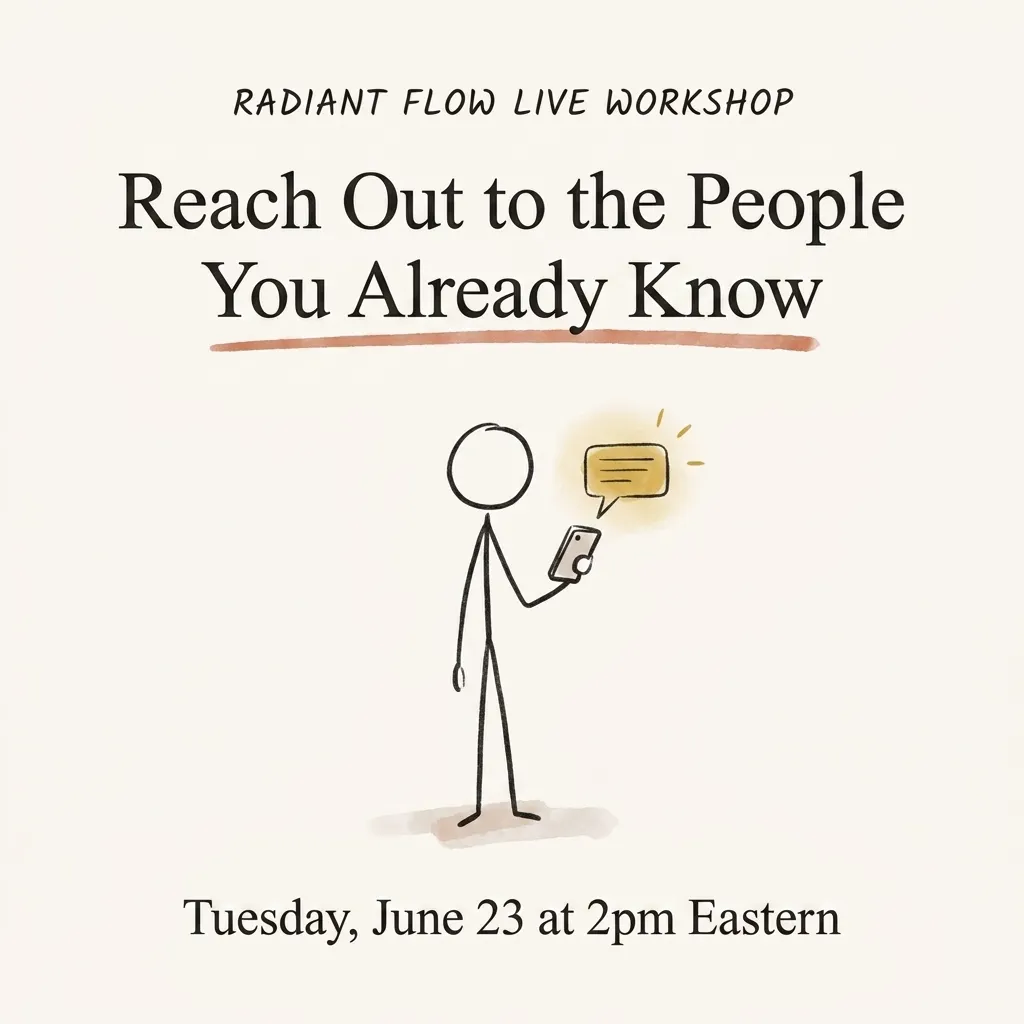
If doing your outreach feels heavy, do it with us instead.
On Tuesday, June 23 at 2pm Eastern we're running a live workshop inside Radiant Flow. Carolina will open us up by settling the body, because the freeze we just talked about lives in your nervous system.
Then I will walk you through the method. We'll make our lists together. Then, with the power of having a community doing this work alongside you, you'll send one meaningful message that needs to be sent.
And you'll leave with clear next steps for the next ones that need to be scheduled. Those who attend live will also walk away with a claude skill workflow to help them organize their personal outreach on an ongoing basis.
Radiant Flow is our embodiment membership, $67 a month: twice-weekly sessions, a vibrant heart-connected community, and live workshops like this one. If you'd like to be there, you can join here:
And if you'd rather just send the one message on your own, do that. What matters most is that you take the next step forward from here.
Phil (& Carolina)