How to Price Intuitive Coaching Well
If you're trying to figure out how to price intuitive coaching, you already know the hard part isn't the math. It's the moment you say a number out loud and your body reacts before your mind catches up. Your throat tightens, your stomach drops, and you start wondering whether the price is too high, too low, or somehow wrong to charge for at all.
That reaction is worth paying attention to. It just shouldn't be the only thing setting your rates.
Intuitive coaching is easy to underprice, because from the outside the work looks soft. You listen. You notice the patterns and track what isn't being said, until you can name the thing underneath the thing. Someone leaves a session clearer than they've felt in months. And because part of what you do comes naturally to you, you talk yourself into believing it isn't worth much.
But natural doesn't mean free. Breathing is natural too. And if someone's nervous system settles in your presence for the first time all week, that is not a small thing.
How to price intuitive coaching without guessing
A price that holds has to do three jobs at once. It has to make sense in your business. It has to feel clean enough in your body that you can say it without your voice wobbling. And it has to match what the work is actually worth and what you're carrying when you do it.
Miss one of the three and the price gets shaky.
If the number only comes from what feels comfortable, you'll set it low enough to keep your own nerves quiet. That buys you one calm afternoon and a business that slowly drains you. Then every new client lands as more weight instead of more support.
If the number only comes from strategy, you end up with something that looks smart in a spreadsheet and feels impossible to say on a call. People feel that split. Not because they're reading your mind. Because everyone can hear hesitation.
So start with the business. Then bring your body with you.
Start with the real cost of running your practice
Open a spreadsheet, or a notebook. Nothing fancy. On one side, write down what it costs you to run this every month: software, rent if you pay it, admin help, insurance, training, taxes, the cut Stripe takes on every payment. Then the hours nobody pays you for, the marketing, the writing, the emails, the follow-up. Most people leave that last part out, and that's exactly where the price gets distorted.
Then write down how many client sessions you can actually hold in a month without starting to resent them. Not the heroic number. The Tuesday afternoon number, the one that still leaves room for notes, rest, your own healing, and being a person.
This is where a lot of intuitive coaches get a useful jolt. They see they've been trying to build a practice on rates that only work if they see far more people than they could ever hold well.
Say you want the practice to cover eight thousand dollars a month, owner pay and overhead together, and you can sustainably hold sixteen one-to-one sessions. That doesn't mean you charge five hundred a session and call it done. But it does tell you something useful. At ninety dollars a session, the math never closes here, no matter how steady you sound saying the number.
That takes some of the shame off. You're not failing at believing in yourself. The numbers just don't add up.
Price the whole offer, not just the hour
Nobody hires intuitive coaching because they want to spend sixty minutes on your calendar. They come for relief, or clarity, or steadiness, or a piece of truth they couldn't get to on their own.
Which is why pricing by the hour gets strange fast.
When you're good, people get to the heart of something quickly. Charge only for time and you punish your own skill. The better you get, the faster the shift, the less you earn. That's backwards.
For a lot of coaches, a package or a monthly retainer fits the work better. Not because packages sound more professional. Because real change usually needs a rhythm. One session can help. But if you're working with patterns, self-trust, the swings in someone's nervous system, the way they handle a hard relationship or a business decision, one session is the start of the arc, not the whole of it.
So the better question isn't "what do I charge for an hour." It's "what shape gives this work enough room to actually work." That question tends to lead somewhere cleaner.
You might build a three-month coaching package with two sessions a month and some light support in between, or a monthly retainer with a clear scope. Then you price that against the outcome it's pointed at, the access you're giving, what you can hold, and the numbers you already ran.
Use the market as a reference, not a ruler
You do need to know what other people charge. Not to copy them, and not to prove you're the cheap option or the premium one. Just so you know the range your clients are already walking around with.
Look at people with roughly your experience, your audience, your depth of work. Someone six months into intuitive coaching shouldn't price like someone with twenty years of clinical and facilitation work behind them. What you've actually lived counts. So does how much you're holding in the room.
And the market only tells you so much. Someone else's rate works because of their audience, their city, their reputation, the referrals that keep coming. That doesn't mean it works for your practice. Their number is information. It isn't an instruction.
This is where steady discernment earns its keep. You're not trying to win a pricing contest. You're trying to set a number that can hold up a real practice, with real people, over real time.
Why underpricing intuitive coaching backfires
Underpricing usually gets defended as generosity. Sometimes that's true. Often it's fear, and generosity is just the nicer word for it.
A rate that's too low doesn't hurt today. It hurts in a few months. You overbook. You catch yourself quietly irritated at clients who did nothing wrong. You start avoiding your own marketing, because every new yes means more strain. Or you fill your practice with people shopping for the lowest price instead of people ready to do the work.
None of that makes you bad at this. It means the price is carrying weight it was never built to hold.
I've watched people set a rate that sounds compassionate and then build a week they can't recover from. Six sessions crammed into two days. No room to think, no time to follow up. Then confusion about why the whole thing feels so heavy. The price set the pace. The pace ran their nervous system. And the state of their nervous system showed up in every money conversation after that.
This is why Carolina and I keep strategy and the body in the same conversation. She works with the nervous system, I work with the structure, and pricing sits right where the two meet. Your rate isn't only a number on a page. It's part of the system you're asking your body to live inside.
Raise your rates in a way your system can handle
Sometimes the right number is obvious on paper and still feels impossible to say. If that's you, don't force some dramatic leap just to prove you can.
You can raise it gradually and still be honest.
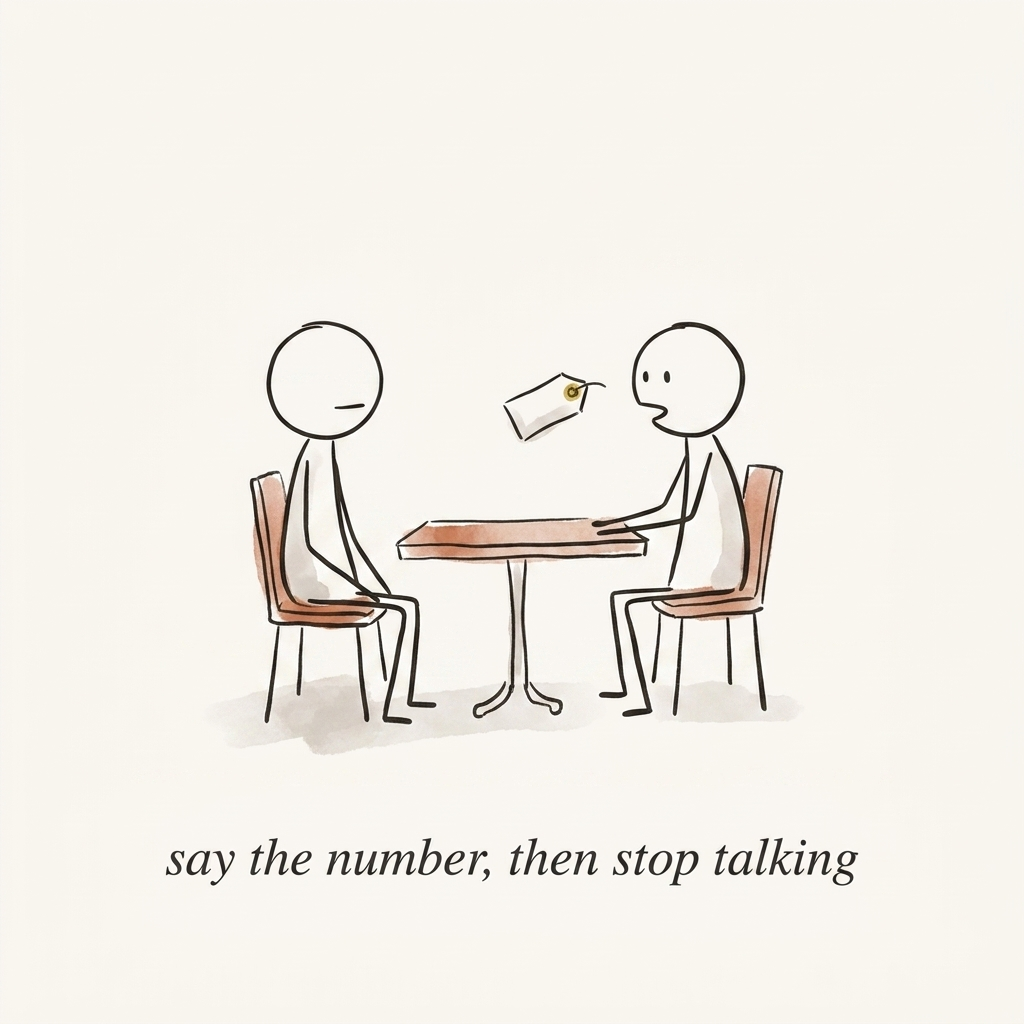
Pick a number that stretches you without sending you into a freeze every time someone asks about working together. Then say it out loud, on your own, until it sounds like an ordinary sentence. Not a speech. A sentence. "My rate is X." Then stop talking.
That last part matters more than it looks. Plenty of coaches name the price and then talk right over it, rushing in with extra explanation, an apology, a discount nobody asked for. The silence is part of a clean price. It leaves the other person room to feel something and answer.
And if your rates are changing, tell the people already with you, plainly and with respect. You don't need a story. A short note does it. The practice has changed, the pricing has changed, here's when the new rate starts.
Leave room for values without making your pricing fuzzy
You might want the work to stay reachable for people who can't pay full rate. That's fair. Reachable just works better when you design it on purpose, instead of improvising it on a call because you can feel someone's pain and your structure quietly dissolves.
So decide the flexibility ahead of time. Maybe you keep a couple of lower-fee spots. Maybe you offer a payment plan. Maybe a lower-cost group comes later. The point is that your values are built into the business by choice, not renegotiated live every time your heart moves.
When the pricing stays vague, every discovery call turns into a private argument with yourself about whether you're a good person. That's exhausting, and it isn't kind to the person across from you either. A clear structure is gentler on both of you.
A clean price says what the work costs. A clean values decision says where you've chosen to bend. Those are two different sentences, and you get to write both.
The most useful question I know here is a plain one. Can you say your price, do the work well, and still have enough left over for your own life? If the answer is no, the price isn't right yet. And usually it's not too high. It's too low.
Set a number that respects the work, the hours nobody sees, and the person who has to come back and do it again next week. That's where good pricing starts.
Phil (& Carolina)